



Constitutional morality refers to adherence to the values, principles, procedures and institutional limitations embodied in the Constitution, rather than merely following its literal provisions. Dr. B.R. Ambedkar regarded constitutional morality as essential for the peaceful functioning of democracy. It combines respect for constitutional forms and authority with freedom of speech, lawful dissent, criticism of public authorities and faith in constitutional institutions.
The Supreme Court aptly described constitutional morality as the “fulcrum which acts as an essential check upon the high functionaries and citizens alike”. As experience has shown that unbridled power without any checks and balances would result in a despotic and tyrannical situation which is antithetical to the very idea of democracy.
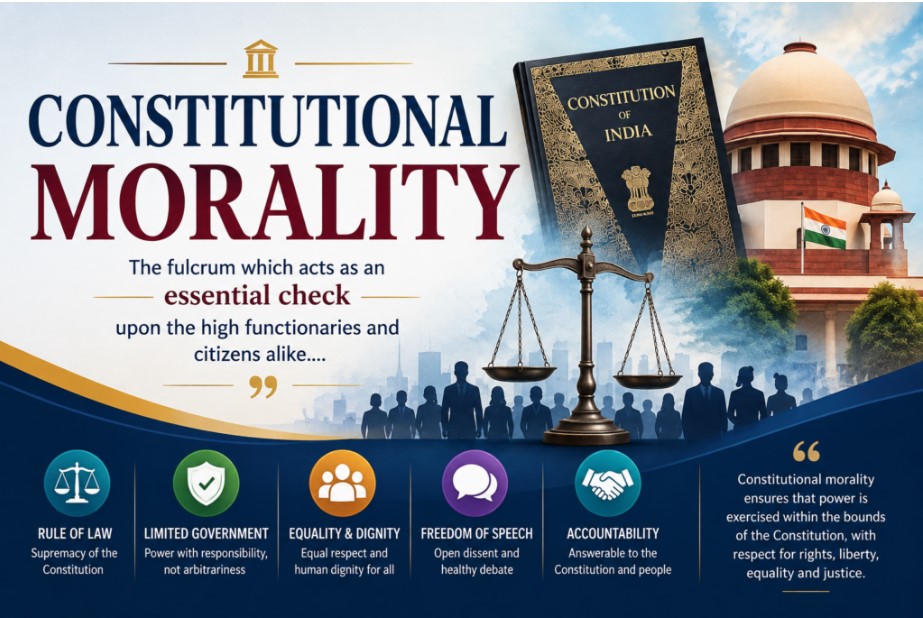
Meaning and Dimensions of Constitutional Morality
Constitutional morality goes beyond constitutional legality. While legality asks whether an action conforms to the text of law, constitutional morality examines whether it is consistent with the spirit, values and democratic purposes of the Constitution.
Its important dimensions include:
- Rule of law and limited government
- Separation of powers and institutional checks and balances
- Fundamental rights and individual dignity
- Equality, liberty and fraternity
- Democratic accountability and transparency
- Respect for constitutional procedures and institutions
- Protection of dissent and pluralism
In Kalpana Mehta v. Union of India, the Supreme Court observed that constitutional morality is embedded in constitutional provisions and may also be discerned from constitutional silence. Justice D.Y. Chandrachud emphasised that constitutional interpretation must identify what the Constitution is fundamentally seeking to achieve and should flow from constitutional morality.
Thus, constitutional morality acts as a normative compass for constitutional interpretation and governance.
Constitutional Morality and Judicial Independence
An independent judiciary is indispensable to rule of law and constitutional supremacy. Judicial independence means that judges must be able to decide cases without fear, favour, political pressure or extraneous influence.
In S.P. Gupta v. Union of India, the Supreme Court recognised fearless adjudication as central to judicial independence. Similarly, in Supreme Court Advocates-on-Record Association v. Union of India (1993), judicial independence was recognised as essential for democracy and effective constitutional adjudication.
Independence enables courts to:
- Protect fundamental rights;
- Review legislative and executive action;
- Enforce constitutional limitations; and
- Act as a check against majoritarian or arbitrary exercise of power.
Thus, constitutional morality protects judicial independence by ensuring that political convenience cannot override constitutional principles.
Constitutional Morality and Judicial Accountability
However, independence cannot mean immunity from accountability. Constitutional morality requires judges and judicial institutions themselves to remain subject to constitutional values, ethical standards, transparency and public confidence.
In Central Public Information Officer, Supreme Court of India v. Subhash Chandra Agarwal, the Supreme Court held that judicial independence does not contradict transparency. The Court brought the office of the Chief Justice within the framework of the Right to Information Act, 2005, while emphasising that disclosure must be determined by balancing competing public interests.
Judicial accountability may involve:
- Transparency in institutional functioning;
- Declaration of assets;
- Ethical judicial conduct;
- Reasoned judgments;
- Institutional scrutiny;
- Appropriate mechanisms for dealing with misconduct; and
- Accountability to the Constitution, law and the public.
Striking the Balance
Judicial independence and accountability are not opposing principles but complementary dimensions of constitutional morality.
| Judicial Independence | Judicial Accountability |
| Freedom from external pressure | Responsibility towards constitutional values |
| Protects impartial adjudication | Protects public confidence |
| Enables judicial review | Prevents abuse of judicial power |
| Shields judges from political retaliation | Ensures transparency and ethical conduct |
The balance requires neither an externally controlled judiciary nor an unaccountable judiciary. Excessive external control can undermine independence, while complete insulation can encourage arbitrariness.
The Supreme Court’s approach in Government of NCT of Delhi v. Union of India (2023) illustrates this broader principle. The Court stressed that constitutional morality operates as a check against the unbridled exercise of power, preserving the constitutional distribution of authority and democratic accountability.
Conclusion
Constitutional morality therefore provides the middle path between judicial autonomy and judicial answerability. It protects judges from political interference while simultaneously requiring them to remain faithful to constitutional values, transparency and institutional responsibility.
As Ambedkar envisaged, constitutional morality ultimately requires that constitutional forms, democratic dissent, institutional restraint and respect for opposing viewpoints coexist. Hence, an independent judiciary becomes truly legitimate not merely when it is free from external control, but when its independence is exercised within the discipline of the Constitution and in the service of constitutional democracy.