



How the theories of postmodernism are relevant in promoting social justice and empowerment of marginalised communities? [20 Marks- UPSC 2025]
Introduction
Postmodernism in anthropology emerged in the 1970s as a critique of modernist claims of objectivity, neutrality, and universal truth. Postmodern theorists questioned whether any single anthropologist could provide a complete and unbiased account of a culture. By challenging the authority of Western scientific knowledge and highlighting the contextual nature of all knowledge systems, postmodernism became highly relevant in promoting social justice and empowering marginalised communities.
Body
1. Challenging Claims of Neutral and Universal Knowledge
Postmodernism argues that science and rationality are not universal but historically and culturally specific, shaped largely by Western European and North American contexts. When such frameworks are applied uncritically to other societies, they may distort local realities. By asserting that every society has its own ways of knowing the world, postmodernism rejects the idea of Western knowledge as inherently superior. This creates space for recognising indigenous, local, and marginalised knowledge systems as equally valid, thereby supporting epistemic justice.
2. Rethinking Fieldwork and Research Authority
Postmodern theorists emphasise that fieldwork is never neutral. What anthropologists observe depends on their identity, background, timing, and interactions in the field. Knowledge is therefore partial and situated. This critique undermines the traditional authority of the lone ethnographer and highlights the need to acknowledge multiple perspectives. By recognising how gender, ethnicity, age, or power relations shape research outcomes, postmodernism prevents the silencing of marginalised voices and promotes more inclusive representations.
3. Voice, Representation, and Epistemic Violence
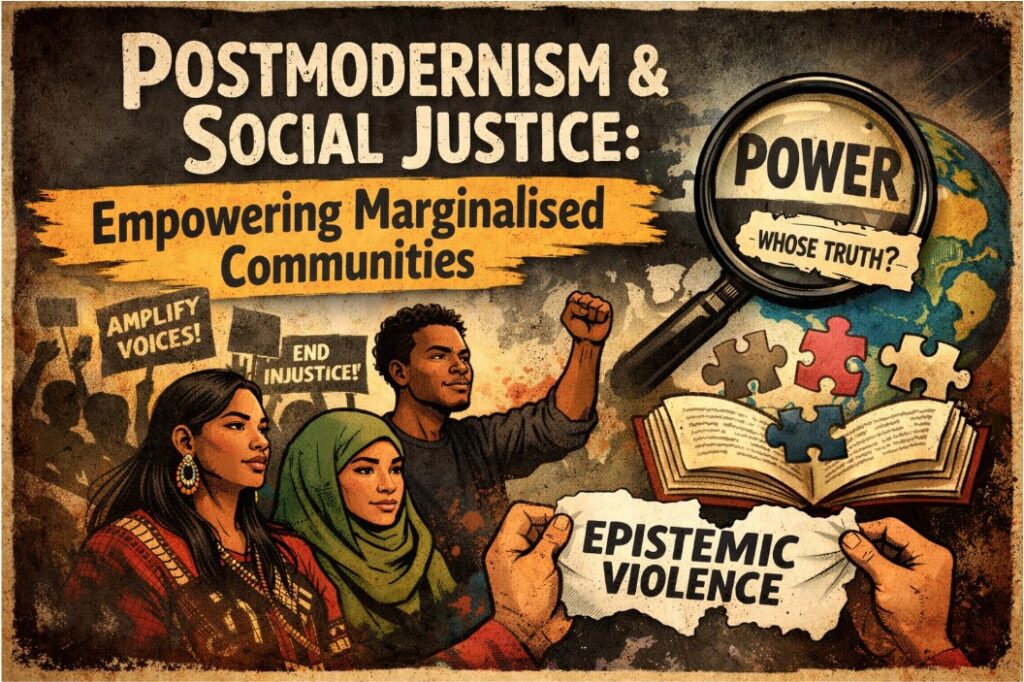
A central postmodern concern is whose voice counts in ethnography. Historically, anthropology was dominated by white, male, Western scholars, often marginalising women, minorities, and non-Western communities. Postmodernists describe this exclusion as epistemic violence—the distortion or erasure of alternative perspectives by dominant knowledge systems. By exposing such practices and calling attention to misrepresentations—such as portraying enslaved Africans merely as “workers”—postmodernism encourages anthropology to actively amplify suppressed voices.
4. Reflexive Writing and Textual Deconstruction
Postmodernism highlights that ethnographic writing is an act of interpretation rather than objective reporting. Scholars such as Jean Briggs, Clifford Geertz, Paul Rabinow, and Renato Rosaldo introduced reflexive writing, acknowledging personal experiences and emotions in knowledge production. Deconstruction further examines how texts privilege certain meanings while suppressing others, enabling recovery of silenced histories and perspectives.
Conclusion
By questioning authority, exposing epistemic violence, recognising multiple ways of knowing, and recovering marginalised voices through reflexivity and deconstruction, postmodern theories make anthropology more ethically responsible. In doing so, postmodernism directly contributes to social justice by empowering marginalised communities and challenging dominant structures of knowledge and representation.