



Write a note on Mousterian tool tradition, Mousterian culture and its makers. — [15 Marks UPSC-2025]
Introduction
The Mousterian tool tradition represents one of the most significant cultural developments of the Middle Palaeolithic period. It marks a transitional phase between the Lower Palaeolithic Acheulian culture and the later Upper Palaeolithic industries. Associated primarily with the Neandertals in Europe and the Near East, the Mousterian tradition reflects technological refinement, adaptive strategies, and debates about the cognitive and cultural capacities of its makers.
Body
Chronological and Cultural Context
The Mousterian tradition belongs to the Middle Palaeolithic period, dating approximately from 300,000 to 40,000 years ago in Europe and the Near East. In Africa, the equivalent period is known as the Middle Stone Age, and the industries are often referred to as post-Acheulian.
The term “Mousterian” is derived from the rock shelter of Le Moustier in the Dordogne region of France, named by De Mortillet in the nineteenth century. The culture represents a continuation and refinement of the Acheulian tradition rather than a complete break from it.
Mousterian Tool Tradition
The Mousterian tool assemblage differs markedly from Acheulian industries in both proportion and technique.
(a) Shift from Core Tools to Flake Tools
- In contrast to Acheulian assemblages dominated by large core tools such as hand axes and cleavers, the Mousterian shows:
– A decline in large hand axes (from up to 40% in early sites to less than 8% in later ones).
– An increase in small flake tools, especially scrapers and points. - Scrapers became the dominant tool type.
- Projectile points suggest hunting specialization.
(b) Retouching and Refinement
A key feature of the Mousterian is the use of retouched flakes, where edges were deliberately shaped by removing small chips. This indicates planning and technical skill rather than random flaking.
(c) Levallois Technique
A major innovation was the Levallois technique, which involved:
- Preparing a core carefully.
- Creating a striking platform.
- Producing flakes of predetermined size and shape.
Although Levallois flakes appear earlier, they are more frequent in Mousterian tool kits. This method demonstrates foresight and cognitive planning.
(d) Hafting and Specialized Use
Some projectile points were thinned or shaped on one side, suggesting hafting—attachment to wooden shafts or handles.
Use-wear studies indicate that:
- Scrapers were used for working hides.
- Tools were used for woodworking and butchery.
(e) Bone Tools
Although predominantly a stone tool tradition, some Mousterian sites contain bone artifacts, and in certain sites bone tools were prominent.
Mousterian Culture
The Mousterian culture reflects more than tool-making; it reveals adaptation, subsistence strategies, and possibly symbolic behavior.
(a) Adaptive Continuation of Acheulian
The Mousterian represents:
- A refinement of Acheulian traditions.
- Greater variety and specialization of tools.
- Reduced emphasis on the hand axe.
(b) Variability
Middle Palaeolithic sites show significant variation in tool types and frequencies. This suggests:
- Regional adaptations.
- Functional differences.
- Possibly cultural diversity among Neandertal groups.
(c) Debate on Symbolism
There is debate regarding the cultural sophistication of Neandertals:
- Some scholars argue that Mousterian tools were purely utilitarian.
- Others, such as Francesco d’Errico, point to bone tools, jewelry, and incised patterns (e.g., Arcy-sur-Cure) as evidence of symbolic behavior.
The presence of regular notches and decorative objects suggests that Neandertals may have possessed cognitive capacities comparable to modern humans.
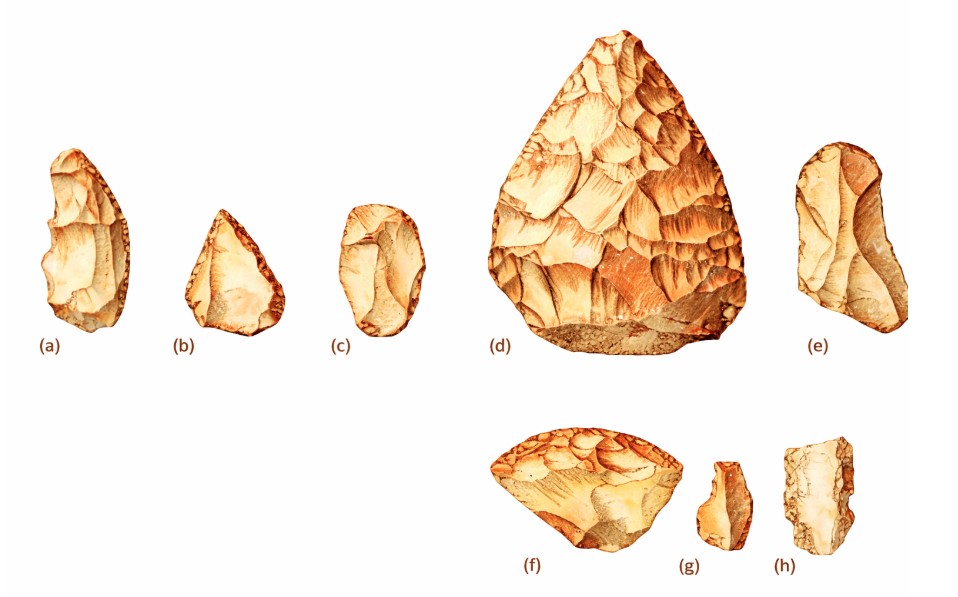
Mousterian Industries (a) Typical Mousterian, convex side scraper; (b) typicalMousterian, Mousterian point; (c)Mousterian of Acheulean, backed knife; (d) Mousterian of Acheulean,hand axe (e)Mousterian of Acheulean, end scraper; (f) Quina-type Mousterian, traverse scraper; (g) and (h) denticulate Mousterian tools.
Makers of the Mousterian Culture
The Mousterian tradition is most commonly associated with the Neandertals (Homo neanderthalensis).
- The first Neandertal skeleton was discovered in 1857.
- In 1864, King designated it as Homo neanderthalensis.
- In 1886 at Spy (Belgium), Neandertal skeletons were found in direct association with Mousterian artifacts, confirming the cultural link.
However:
- Some non-Neandertal populations are also associated with Mousterian assemblages.
- Non-Mousterian traditions coexisted during Neandertal times.
Thus, while Neandertals are the principal makers, the cultural picture is complex.
Conclusion
The Mousterian tool tradition represents a significant stage in human technological and cultural evolution. Characterized by a shift toward flake tools, the Levallois technique, retouching, and hafting, it reflects advanced planning and adaptation. Associated mainly with Neandertals, the Mousterian culture demonstrates both technological refinement and possible symbolic expression. Far from being merely primitive toolmakers, the makers of the Mousterian tradition reveal intellectual capacities and adaptive strategies that mark an important chapter in the story of human evolution.