



Introduction
The study of kinship has long occupied a central place in anthropological inquiry. Within this domain, genealogies and pedigrees serve as crucial tools for understanding descent, alliance, social organization, and demographic patterns. Although the terms are often used interchangeably, they represent analytically distinct concepts. A clear differentiation between pedigree and genealogical analysis is essential for understanding their methodological significance, historical development, and application in anthropological research.
Body
Differentiation between Pedigree and Genealogical Analysis
Conceptual Distinction
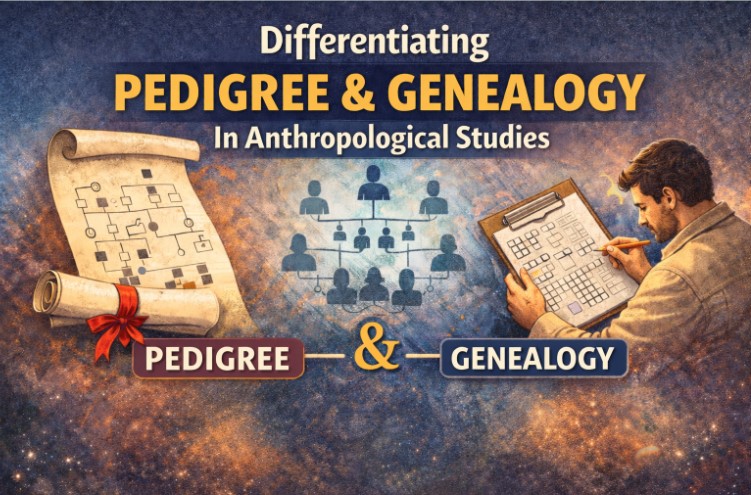
A pedigree refers to a genealogical statement made by an actor or informant. It may be oral, written, or diagrammatic and represents how individuals perceive and present their descent from particular ancestors. Fortes described pedigree as a “charter” through which a person establishes descent from a specified ancestor, often to assert rights, status, or group membership. Pedigrees are embedded in cultural context and may function as legitimizing documents for property, office, or social rank.
In contrast, a genealogy, in anthropological usage, is a genealogical statement constructed by the ethnographer as part of fieldwork records and analysis. It is a systematic reconstruction of kinship connections based on data collected from multiple informants, cross-checked for consistency, and organized according to scientific criteria. Genealogy aims not merely to record claims but to analyze actual or socially recognized relationships over time.
Thus, while pedigree reflects actors’ perspectives and cultural representations, genealogy represents the ethnographer’s analytical framework.
Nature and Scope
Pedigrees are typically selective. They often emphasize unilineal lines—patrilineal or matrilineal—while ignoring other possible lines of descent. In many societies, only a limited number of generations are remembered, and earlier ancestors may be telescoped, fused, or modified. Pedigrees may contain mythological or symbolic elements and may not always be historically accurate.
Genealogical analysis, on the other hand, seeks comprehensiveness. The ethnographer attempts to record all cognatic and affinal connections, including spouses, siblings, adopted children, and multiple marriages. It includes demographic details such as dates of birth, marriage, death, residence, and occupation. Unlike pedigree, which may be shaped by cultural memory and political needs, genealogy is structured by methodological rigor and aims at analytical precision.
Function and Purpose
Pedigrees often serve social and political purposes. In Europe, written pedigrees established noble descent and legal rights. In China, India, Samoa, and other societies, genealogies functioned as records of lineage continuity and group identity. In some tribal societies, oral pedigrees legitimize claims to land, status, or office.
Genealogical analysis serves scientific purposes. It enables anthropologists to:
- Infer the structure of kinship systems.
- Understand rules of descent and marriage.
- Construct demographic and statistical models.
- Analyze social organization, group formation, and alliance patterns.
Thus, pedigree is a cultural document; genealogy is an analytical instrument.
Historical Development
Genealogical information was recorded by early travelers and colonial administrators. One of the earliest tribal genealogies was collected by Sir George Grey in Western Australia in 1841.
In the nineteenth century, L. H. Morgan systematically investigated kinship terminologies across societies. While Morgan stimulated interest in kinship classification, he did not develop a method for systematic genealogical recording.
The methodological breakthrough came with W. H. R. Rivers’ work in the Torres Strait (1900, 1904, 1910). Rivers formalized the genealogical method, demonstrating its utility for understanding both genetic and socially recognized kinship. His approach laid foundations for later developments in social demography and statistical modeling. Rivers’ systematic recording of kin relations became a standard ethnographic technique.
Twentieth-century anthropologists such as Evans-Pritchard (Nuer), Fortes, and others deepened interest in how people perceive ancestry and construct pedigrees. Scholars noted that pedigrees may be historically inaccurate yet socially meaningful.
Research among the Bedouin (Peters), Luapula peoples (Cunnison), and others revealed processes such as telescoping, fusion of ancestors, and revision of lineages. Pedigrees were shown to reflect ecological adaptation, political organization, and group alignment rather than strict demographic truth.
These insights marked a shift from treating genealogies as historical records to analyzing them as cultural and sociological constructs.
Application in Anthropological Studies
1. Kinship and Social Organization
Genealogical analysis helps identify descent groups, lineages, moieties, and sections. It distinguishes between genealogical charts (actual kin relations), terminological diagrams (classification of kin terms), and prescriptive diagrams (marriage rules). This differentiation clarifies how real relations differ from logical kinship systems.
2. Social Demography
Genealogies provide data on fertility, marriage patterns, adoption, polygyny, divorce, and residence shifts. They are essential for constructing demographic models and understanding population structure.
3. Political and Economic Rights
Pedigrees often function as charters legitimizing claims to land, office, or ritual authority. Anthropologists analyze these documents to understand how descent narratives sustain social hierarchies
4. Cultural Perceptions of Ancestry
The study of pedigrees reveals how societies remember or forget ancestors. Some cultures emphasize long unilineal lines; others show little interest in remote ancestry. Processes such as name inheritance, teknonymy, or age-set organization influence genealogical memory.
5. Methodological Refinement
Ethnographers record genealogies narratively before constructing charts. They must verify social versus biological parentage, distinguish adoption from birth, and adapt procedures to local cultural logic. Genealogical method thus requires methodological flexibility and cultural sensitivity.
Conclusion
Pedigree and genealogical analysis, though related, differ fundamentally in nature and purpose. Pedigree represents culturally constructed statements of descent serving social, political, and symbolic functions. Genealogical analysis is the ethnographer’s systematic reconstruction of kin relations for scientific inquiry. Historically, from early colonial records to Rivers’ methodological innovations and later analytical refinements, these methods have become indispensable tools in anthropology. Their application extends from kinship studies and social demography to political organization and cultural memory. Together, they illuminate both how societies structure kinship and how they narrate and legitimize their past.