



Introduction
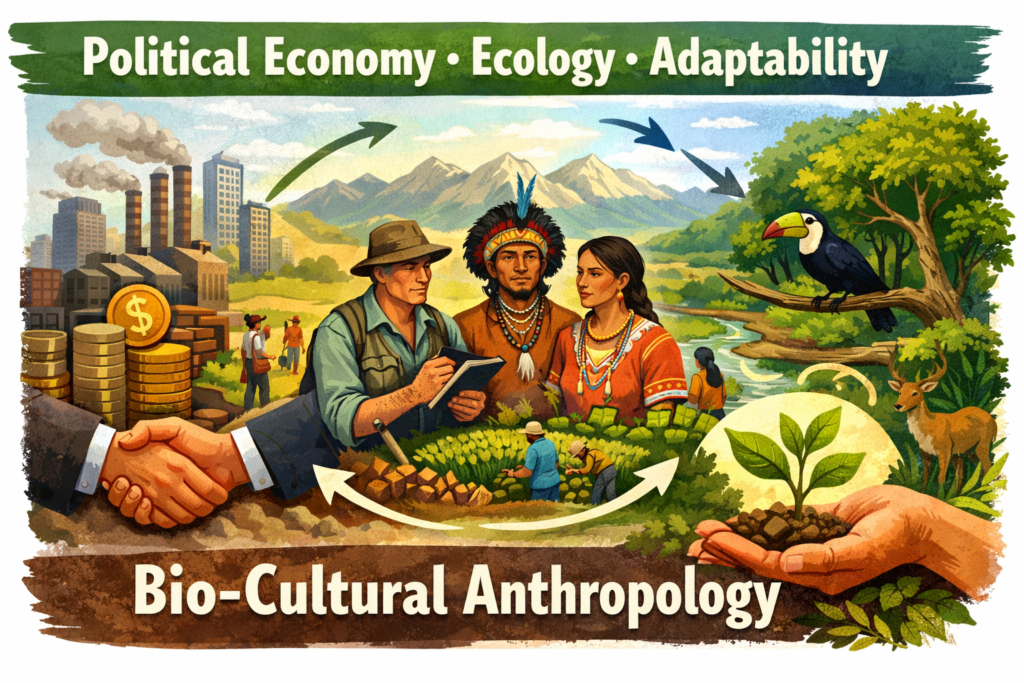
Bio-cultural anthropology seeks to understand human biology as a dynamic outcome of interactions between culture, ecology, and social structures. Within this framework, the political economy perspective is integrated with ecological and adaptability approaches to explain how power relations, economic systems, and historical processes shape ecological conditions and constrain or enable human biological adaptation. Thus, adaptation is viewed not merely as a response to nature, but as a response to politically structured environments.
Body
From cultural ecology to political economy
Early cultural ecology emphasized how subsistence systems and technologies enabled populations to adapt to their natural environments. However, this approach often treated the environment as neutral. Bio-cultural anthropology expands this view by integrating political economy, which highlights how access to land, resources, labor, and markets is shaped by class relations, state policies, colonial histories, and global capitalism. This synthesis recognizes that ecological conditions themselves are socially produced.
Political mediation of ecological stress
Ecological stresses such as food scarcity, disease exposure, and environmental degradation are frequently outcomes of political and economic processes rather than natural limits. Industrial production, capitalist markets, wage labor, and finance capital restructure local ecologies, altering diets, workloads, and disease environments. Consequently, ecological pressures are unevenly distributed across populations based on class, gender, and ethnicity.
Adaptability as constrained and differential
In bio-cultural anthropology, adaptability includes physiological, developmental, and behavioral responses. Political-economic inequalities influence: Nutrition and growth (e.g., chronic undernutrition leading to stunting), Health and disease patterns (linked to housing, sanitation, and healthcare access), Stress responses (due to insecure livelihoods and social marginalization).
These responses may allow short-term survival but often carry long-term biological costs, showing that not all responses are true adaptations. The poorest and most powerless groups may be pushed beyond adaptive limits.
Embodiment of inequality
A key concept linking political economy with adaptability is embodiment—the process by which social and economic inequalities become biologically expressed in bodies across the life course and generations. Poverty, labor exploitation, and social exclusion leave measurable biological signatures, making human biology a record of historical and political processes.
Holistic biocultural explanation
By integrating political economy with ecological and adaptability perspectives, bio-cultural anthropology avoids both biological determinism and ecological reductionism. It connects micro-level biological variation with macro-level global processes, such as colonialism, market penetration, and neoliberal reforms.
Conclusion
In bio-cultural anthropology, political economy is integrated with ecological and adaptability perspectives by demonstrating that human adaptation occurs within unequal, politically structured ecological systems. Ecology provides the environmental context, adaptability explains biological responses, and political economy reveals how power and inequality shape both. This integrated approach offers a comprehensive understanding of human diversity, health disparities, and the biological consequences of social injustice—making it especially relevant for contemporary anthropological analysis