



Discuss the Miocene hominoid remains and their significance in evolution. — [20 Marks UPSC 2025]
Introduction
The Miocene epoch (22–5 million years ago) represents a crucial phase in primate evolution, marked by significant climatic changes and geological events, particularly the collision of Africa and Eurasia. These transformations altered habitats from dense tropical forests to a mosaic of grasslands, woodlands, and ecotones. Within this dynamic environmental context, hominoids (apes) became diverse, abundant, and widely distributed across Africa, Europe, and Asia, making the Miocene a pivotal period for understanding the origins and evolution of modern apes and humans.
Body
Diversity and Distribution of Miocene Hominoids
Unlike the Oligocene, where fossil evidence is limited, the Miocene provides rich fossil records from over 110 sites across the Old World. These include hundreds of primate specimens, mostly dental remains but also increasing postcranial material.
- Hominoids during this period were diverse, abundant, and widespread.
- Fossil apes appeared for the first time in large numbers, making it difficult for experts to agree on their exact evolutionary relationships.
- Three major lineages emerged: One leading to gibbons and siamangs , two others: Dryopithecines and Ramapithecines
Major Hominoid Families and Their Characteristics
(a) Dryopithecidae
- Distribution: Old World (Africa, Europe, Asia)
- Time range: 23–8 million years ago
- Lifestyle: Forest-dwelling, fruit-eating
Key genera:
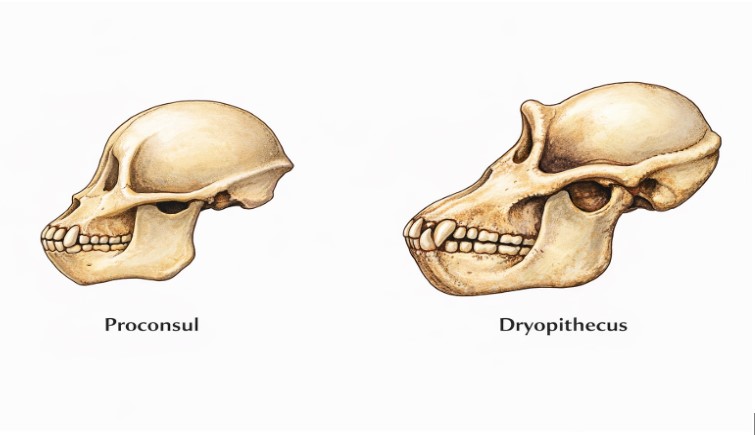
- Proconsul: Early Miocene, arboreal quadruped, less ape-like
- Dryopithecus: Later Miocene, larger, partly terrestrial, more ape-like
Features:
- Small molars with thin enamel , adapted to soft fruit diet
- Primarily arboreal, later becoming more terrestrial
- Likely ancestors of modern apes (Pongidae)
- May include the last common ancestor of apes and humans
(b) Ramapithecidae
- Distribution: Africa, Europe, Asia
- Time range: 14–8 million years ago
- Habitat: Woodland and woodland–savannah edge
Key genera:
- Ramapithecus: Smaller, more hominid-like features
- Sivapithecus: Larger, more terrestrial
- Gigantopithecus: Largest primate, terrestrial vegetarian
Features:
- Large molars with thick enamel suited for grinding coarse food
- Omnivorous diet (seeds, nuts, fruits)
- Adapted to more open environments
- Represent a shift from forest to woodland foraging
Special Forms and Evolutionary Experiments
Oreopithecus
- Exhibits a mosaic of features seen in apes, monkeys, and humans
- Demonstrates how evolution can produce mixed anatomical traits
- Its classification remains debated, reflecting evolutionary complexity
Pliopithecus and Limnopithecus
- Linked to gibbon-siamang lineage
- Show early dental similarity but lack specialized locomotion (brachiation)
- Indicate that locomotor adaptations evolved later than dentition
Comapring Procunsul and Dryopithecus skulls
Key Evolutionary Trends
(a) Adaptive Divergence
- Two major strategies emerged:
- Forest adaptation (Dryopithecidae)
- Woodland/ecotone adaptation (Ramapithecidae)
(b) Shift to Terrestriality
- Increasing movement from trees to ground
- Development of quadrupedal locomotion in mixed habitats
(c) Dietary Diversification
- From soft fruit diet to coarse, varied diets
- Reflected in dental adaptations (enamel thickness, molar size)
(d) Emergence of Ecotone Adaptation
- Some primates adapted to woodland–grassland edges (ecotones)
- These environments required greater adaptability , complex foraging strategies, enhanced social coordination
This ecological shift is considered crucial for the origin of hominids.
Significance in Human Evolution
- The Miocene hominoids represent a critical transitional stage in evolution, marking the period when the line leading to modern apes and humans began to diverge. The concept of the “missing link” is most meaningfully situated within these Miocene forms, as they likely include the last common ancestor shared by Pongidae and Hominidae.
- This period demonstrates adaptive radiation, where hominoids diversified into multiple ecological niches. While some groups (Dryopithecidae) remained in dense forests as fruit-eaters, others (Ramapithecidae) moved into more open woodlands and ecotones, showing increased ecological flexibility, which is a key precursor to human evolution.
- The fossil evidence highlights important functional and anatomical shifts, especially in dentition. Differences in molar size and enamel thickness indicate a transition from soft fruit diets to coarse and varied food resources, reflecting broader adaptive strategies necessary for survival in changing environments.
- The emergence of forms like Ramapithecus illustrates the growing resemblance to hominids, particularly in dental structure. However, the absence of clear evidence for bipedal locomotion suggests that these forms were not true hominids but rather potential ancestral stock from which hominids later evolved.
- The concept of ecotone adaptation (preference for woodland–grassland edges) is especially significant. These environments demanded greater adaptability, varied foraging behavior, and possibly more complex social coordination. Such conditions likely favored traits that later became characteristic of hominids, including flexibility in diet and behavior.
- The Miocene also highlights the mosaic nature of evolution, as seen in forms like Oreopithecus, which combined features of apes, monkeys, and humans. This demonstrates that evolution does not proceed linearly but through combinations of traits appearing in different lineages.
- Overall, the Miocene hominoids provide the foundation for understanding the origin of hominids, as they capture the evolutionary processes—divergence, adaptation, and experimentation—that eventually culminated in the emergence of bipedal, tool-using humans in the later epochs.
Conclusion
The Miocene epoch stands as a decisive phase in primate evolution, characterized by the radiation, diversification, and ecological adaptation of hominoids. The fossil remains from this period reveal critical evolutionary experiments in diet, locomotion, and habitat use, ultimately setting the stage for the divergence of apes and humans. Although debates persist regarding specific lineages such as Ramapithecus, the Miocene hominoids collectively provide indispensable evidence for understanding the origins of the human lineage, particularly the transition toward terrestriality, ecological flexibility, and eventually bipedalism.