



Introduction
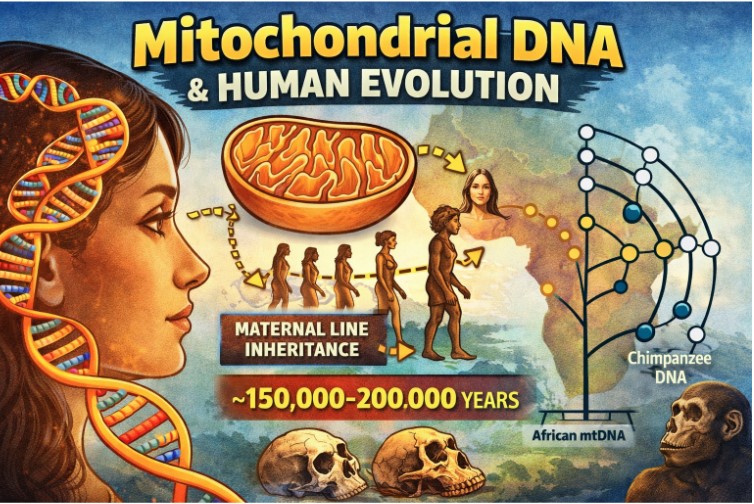
Mitochondrial DNA (mtDNA) is a small amount of genetic material found in the mitochondria of cells. Unlike nuclear DNA, it is inherited exclusively through the maternal line, as only the egg contributes mitochondria during fertilization. This unique mode of inheritance makes mtDNA an important tool for tracing lineage and studying human evolutionary history, particularly the origin and diversification of modern humans.
Body
Nature and Inheritance of mtDNA
- mtDNA is transmitted only from mother to offspring, passing unchanged (except for mutations) across generations.
- An individual inherits mtDNA from their mother, who inherited it from her mother, forming a continuous maternal lineage.
- Females transmit mtDNA, whereas males do not contribute to its transmission.
- This pattern allows scientists to reconstruct maternal ancestry over long time periods.
mtDNA Evidence in Human Evolution
- Early studies conducted in the laboratory of Allan Wilson, using mtDNA samples from populations worldwide, provided the first detailed genetic insights into human origins.
- The results showed that:
- African populations exhibit the highest mtDNA variation, approximately twice that observed in Europeans.
- mtDNA variation outside Africa represents a subset of African variation, indicating a common source.
- These findings strongly support the idea that modern humans originated in Africa.
Phylogenetic Evidence
- A phylogenetic tree constructed using maximum parsimony revealed the relationships among different mtDNA types.
- The tree showed:
- Two major branches
- One branch consisting entirely of African mtDNA types
- The other including all non-African types along with some African types
- The presence of African mtDNA on both branches indicates that Africa is the root of human mtDNA diversity, reinforcing the African origin hypothesis.
Molecular Clock and Dating
- Using the molecular clock approach, scientists estimated the timing of mtDNA diversification.
- Early estimates placed the origin of human mtDNA diversity at about 200,000 years ago.
- Later studies, based on complete mtDNA genome sequences, refined this estimate to around 150,000 years ago.
- These timelines are consistent with the Recent African Origin (RAO) model of human evolution.
Criticism and Clarifications
- Initial findings (1987) faced several criticisms and misunderstandings:
- The idea of a common maternal ancestor (“Eve”) was wrongly interpreted as all humans descending from a single woman, rather than referring only to mtDNA lineage.
- Concerns were raised about the use of African-American samples, due to possible European admixture.
- Questions were also asked about the accuracy of molecular clock estimates and phylogenetic methods.
- Subsequent research clarified that:
- African-Americans largely retain African mtDNA lineages
- Improved analytical methods and larger datasets supported the original conclusions
Later Developments
- Further studies using complete mtDNA genome sequences strengthened earlier findings.
- By rooting the phylogenetic tree with a chimpanzee mtDNA sequence, scientists confirmed:
- The presence of African mtDNA types on both primary branches
- An estimated origin of mtDNA diversity around 150,000 years ago
- These results provided overwhelming support for the African origin of human mtDNA.
Limitations of mtDNA
- mtDNA represents only a single genetic locus, not the entire genome.
- Its evolutionary history may differ from that of populations due to:
- Genetic drift (chance effects)
- Natural selection acting on mtDNA
- Therefore, mtDNA evidence alone is insufficient to fully explain human evolution, and must be supplemented with other genetic and fossil evidence.
Conclusion
Mitochondrial DNA has provided crucial insights into human evolution by offering strong genetic evidence for an African origin of modern humans. Its maternal inheritance and global variation patterns make it a powerful tool for tracing ancestry. However, since it reflects only one genetic lineage, a comprehensive understanding of human evolution requires integration with additional genetic and archaeological evidence.