



“The agenda of biological anthropology became more scientific from the middle of the twentieth century.” Justify. — [15 Marks UPSC 2025]
Introduction
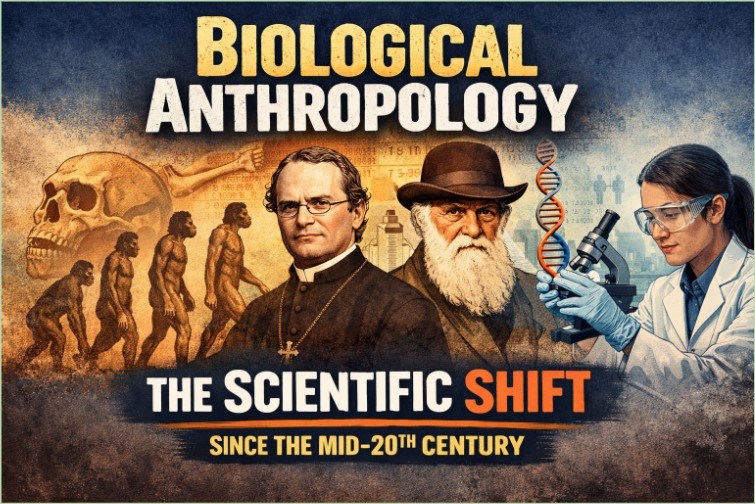
The middle of the twentieth century marks a decisive shift in physical (biological) anthropology from a largely descriptive discipline to a more scientific and analytical one. This transformation was driven by new evidence, theoretical frameworks, and methodological advancements that emphasized explanation over mere observation.
Body
The increasing scientific nature of biological anthropology after 1940 can be understood through four major developments:
1. Fossil Discoveries and Evolutionary Evidence
The discovery and description of major fossil forms provided strong support for the view that humans are products of evolution. These fossils offered direct evidence of the course of human ancestral development, making the study of human origins more empirical and evidence-based.
2. Established Relationship Between Humans and Apes
Anatomical, physiological, and emerging behavioral similarities between humans and apes were firmly established. This reinforced the evolutionary framework and provided a comparative basis for scientific analysis of human evolution.
3. Detailed Study of Human Variation
Anthropometric and genetic variation across human populations had been extensively documented. This descriptive data now demanded interpretation—raising scientific questions about human adaptability, evolution, and the meaning of variability.
4. Shift from ‘Race’ to Natural Populations
The concept of race was replaced by the study of natural populations as units of analysis. Using methods developed by population geneticists, evolution came to be understood as changes in the genetic structure of populations. This marked a clear move toward quantitative and theoretical approaches.
These developments were unified by an evolutionary perspective, which transformed the discipline. Rather than merely collecting data, anthropologists began to:
- Formulate specific research problems
- Interpret data within theoretical frameworks
- Shift focus from description to explanation
This transformation was so significant that it was termed the “new anthropology.”
Further, the goals of biological anthropology expanded, becoming more scientific and application-oriented:
- Reconstruction of human evolutionary history
- Understanding the significance of human variation
- Application of knowledge to real-world problems such as disease, malnutrition, environmental issues, and human adaptation
The field also diversified into new applied subfields such as:
- Nutritional anthropology
- Medical anthropology
- Human ecology
- Human ethology
These developments brought biological anthropology closer to practical human concerns and interdisciplinary approaches.
Conclusion
Thus, from the mid-twentieth century onward, biological anthropology became distinctly more scientific by adopting an evolutionary framework, employing population-based and genetic methods, and shifting from description to problem-oriented research. This transition not only refined its methods and goals but also aligned the discipline with broader human concerns, giving it both theoretical depth and practical relevance.