



‘Genome-wide Disease Association Studies (GWAS) advanced our understanding of health and disease.’ Discuss. — [15 Marks UPSC 2025]
Introduction
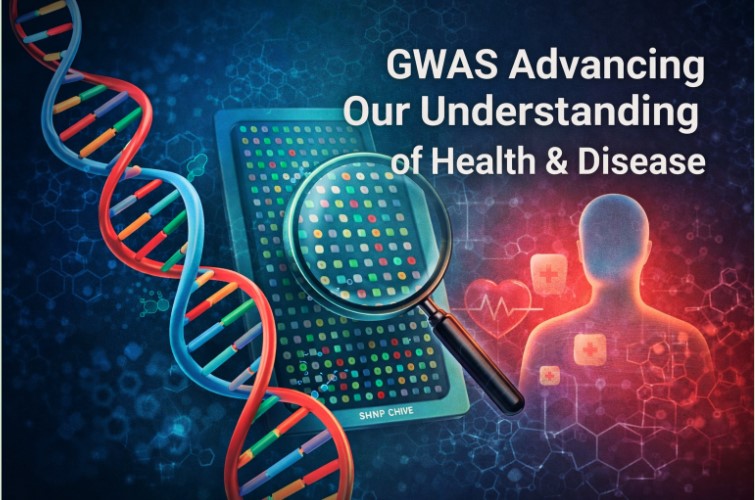
Genome-wide association studies (GWAS) represent a major methodological advance in genetics, made possible by the development of SNP (single nucleotide polymorphism) chips that allow the simultaneous genotyping of hundreds of thousands to millions of genetic variants. GWAS involve comparing genetic variation between individuals with a disease (cases) and those without it (controls) to identify SNPs associated with disease susceptibility. This approach has significantly advanced our understanding of the genetic basis of health and disease by enabling large-scale, unbiased exploration of the genome.
Body
Methodology and Approach of GWAS
GWAS operate on a genome-wide scale rather than focusing on specific candidate genes.
- In a typical GWAS:
- Hundreds of thousands or millions of SNPs are genotyped using SNP chips.
- Genetic profiles of cases (diseased individuals) are compared with controls (healthy individuals).
- SNPs showing higher frequency in cases are identified as being associated with the disease.
- This approach is hypothesis-free, meaning it does not rely on prior assumptions about which genes are involved.
- Consequently, GWAS can identify previously unsuspected genes linked to disease.
Contributions to Understanding Disease
GWAS have produced several important breakthroughs:
- The first GWAS (2005) identified mutations associated with age-related macular degeneration, including genes not previously suspected to be involved.
- A large study in 2007 (involving over 14,000 patients) identified novel genes linked to heart disease, diabetes, and rheumatoid arthritis.
These findings demonstrate that GWAS:
- Reveal new genetic pathways involved in disease
- Expand understanding beyond traditional candidate gene approaches
- Provide insights into the biological mechanisms underlying diseases
Insights into Complex Diseases
One of the most important contributions of GWAS is in understanding complex diseases.
- GWAS findings suggest that diseases such as:
- Heart disease
- Diabetes
- Mental disorders
- are influenced by mutations in multiple genes, rather than a single gene.
- This has led to a shift from single-gene models to polygenic models of disease.
- Additionally:
- The same disease may arise from different genetic mutations in different individuals
- Genetic susceptibility does not guarantee disease occurrence
- Environmental factors also play a crucial role, meaning disease risk is shaped by gene–environment interactions.
Thus, GWAS have deepened understanding of disease as a multifactorial phenomenon.
Limitations and Challenges of GWAS
Despite their successes, GWAS have several limitations:
- Many studies have failed to identify strong candidate genes for certain diseases.
- Identified variants typically confer only a small increase in disease risk (often just a few percent).
- This has led to the problem of “missing heritability”, where known variants cannot fully explain disease occurrence.
- Another challenge is the complexity of genetic variation:
- Each individual may carry upward of a million genetic variants
- Identifying which variants are causally related to disease is extremely difficult
- Because GWAS identify associations rather than causation:
- Associated SNPs may not directly cause disease
- They may instead be linked to the actual causal mutation
These limitations highlight that GWAS, while powerful, are not sufficient on their own to fully explain disease genetics.
Expanding Applications Beyond Disease
Although primarily developed for disease studies, GWAS have broader applications:
- Identification of genes underlying phenotypic traits, such as skin pigmentation
- Detection of signatures of natural selection across the genome
- Contribution to studies of human population history, as SNP chips provide large-scale genetic data
Thus, GWAS have contributed not only to medical genetics but also to molecular anthropology and evolutionary studies.
Future Directions
To overcome limitations of GWAS:
- Researchers are increasingly turning to whole-genome sequencing
- This approach allows detection of all genetic variation, rather than only predefined SNPs
However, challenges remain:
- Interpreting vast genomic data is complex
- Identifying causal mutations among numerous variants is still difficult
Conclusion
Genome-wide association studies have significantly advanced our understanding of health and disease by enabling large-scale, unbiased identification of genetic variants associated with disease susceptibility. They have revealed new genes, highlighted the polygenic nature of complex diseases, and emphasized the importance of gene–environment interactions. However, their limitations—such as small effect sizes, missing heritability, and difficulty in identifying causal variants—indicate that GWAS are part of a broader toolkit rather than a complete solution. As genomic technologies continue to evolve, GWAS will remain a foundational approach, complemented by sequencing and other methods, in unraveling the complex genetic basis of human health and disease.