



Introduction
Forensic anthropology, a vital subfield of physical anthropology, applies the scientific study of human skeletal biology to legal and investigative contexts. When decomposed or skeletal remains are discovered, forensic anthropologists play a crucial role in identifying individuals, reconstructing biological profiles, and assisting in the interpretation of circumstances surrounding death. In addition to these core functions, techniques such as facial reconstruction have gained prominence as tools to aid recognition and identification. Although not definitive, such methods bridge science and art, contributing significantly to forensic investigations.
Body
1. Utility of Human Remains in Forensic Analysis
Human skeletal remains constitute one of the most reliable sources of forensic evidence, especially in cases where soft tissues are absent or degraded.
(a) Reconstruction of Biological Identity
- Forensic anthropologists can derive a biological profile from skeletal remains, including: Age at death, Sex, Stature, Population affinity
- These parameters help narrow down the identity of unknown individuals and assist in matching remains with missing persons.
(b) Establishing Antiquity and Context
- Skeletal remains are often discovered accidentally.
- Anthropologists determine whether remains are: Recent (forensic significance) or Ancient (archaeological context) This distinction is crucial in deciding the legal relevance of the case.
(c) Crime Scene Investigation and Recovery
- Forensic anthropologists bring expertise in archaeological excavation techniques, ensuring: Careful recovery of remains, Preservation of contextual evidence
- This aids in reconstructing: Burial patterns, Post-mortem events , Circumstances surrounding death
(d) Role in Mass Disasters and Criminal Cases
- In large-scale disasters, such as aircraft crashes, skeletal analysis helps in victim identification.
- In criminal investigations, anthropologists assist in: Recovery of fragmented remains , Analysis of evidence in complex crime scenes
- Examples include: Identification of victims in the 1985 Gander aircraft crash , Extensive investigation in the Robert Pickton serial murder case in Canada
(e) Human Rights and Mass Grave Investigations
- Forensic anthropology has become central in investigations of human rights violations.
- Anthropologists assist in: Exhumation of mass graves , Identification of victims of war crimes and political violence
- International organizations rely on such expertise in regions like: Former Yugoslavia , Afghanistan and Iraq
- Teams such as the Argentine and Guatemalan Forensic Anthropology Teams have institutionalized this work.
(f) Use of DNA and Databases
- DNA extracted from skeletal remains can be compared with relatives’ samples for confirmation of identity.
- Development of data banks has enhanced accuracy in identifying “disappeared” persons.
Facial Reconstruction Technique
Facial reconstruction is a specialized technique used when conventional identification methods are insufficient. It aims to create a visual approximation of the individual’s face from the skull to facilitate recognition.
Early methods
- Based on the relationship between the skull structure and soft tissue thickness.
- Early methods involved inserting pins and needles into cadavers to measure tissue depth.
- Over time, more refined data and imaging techniques have improved the process.
Plastic Three-Dimensional Method
- Involves reconstructing the face directly on the skull using clay, wax, or plasticine.
Procedure:
- Placement of tissue-depth markers on anatomical landmarks
- Gradual building of facial muscles and skin
- Addition of features such as eyes, hair, and accessories
Merits:
- Produces a realistic, three-dimensional likeness
- Useful in both forensic and archaeological contexts
Limitations:
- Highly subjective and dependent on artistic interpretation
- Early methods lacked standardized data, affecting accuracy
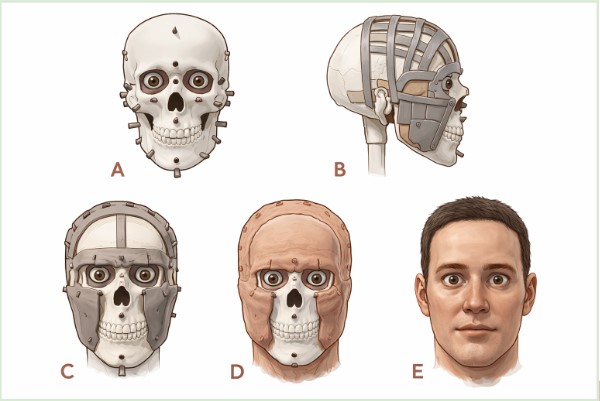
Two-Dimensional Reconstruction-Involves drawing a facial image based on the skull..
Methods:
- Use of tissue-depth data and skull images
- Creation of composite sketches using feature kits or tracing techniques
Advantages: Faster and widely used in police investigations
Limitations: Relies heavily on estimation and artistic judgment
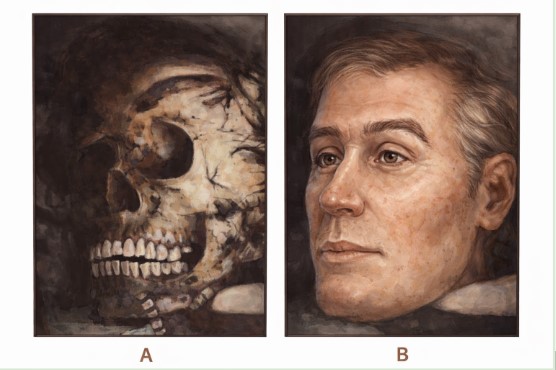
Computerized Reconstruction
- Modern advancements use computer software and imaging technologies
Features:
- Digital scanning of skull with tissue markers
- Use of databases of facial features
- Integration of CT scans and MRI data for improved accuracy
Advantages:
- Faster, reproducible, and allows multiple variations
- Easier modification of facial features
Limitations:
- Does not eliminate subjectivity
- Still constrained by incomplete biological data
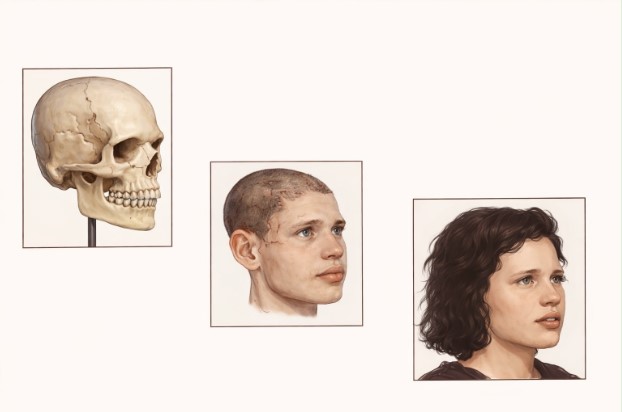
Accuracy and Constraints
- Facial reconstruction cannot produce an exact likeness because:
- Soft tissue features (e.g., lips, hair, skin texture) are not preserved in the skull
- Many traits must be estimated
- Success rate is around 50%, indicating moderate effectiveness
- Hence, reconstructions are referred to as “facial approximations”, not exact reproductions
Conclusion
Human skeletal remains are invaluable in forensic analysis, providing critical insights into identity, context, and circumstances of death. Forensic anthropologists play a multifaceted role in criminal investigations, disaster victim identification, and human rights inquiries. Facial reconstruction, though inherently subjective, serves as a significant supplementary tool by generating visual approximations that can trigger recognition. Despite technological advancements, its limitations necessitate its use alongside other forensic methods. Together, these approaches underscore the indispensable role of forensic anthropology in modern investigative and humanitarian contexts.