



Introduction
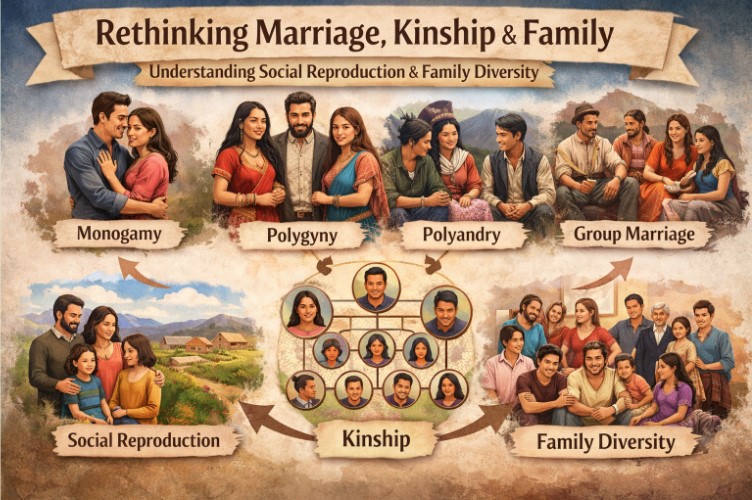
Marriage, though universally present as a social institution, assumes remarkably diverse forms across societies—ranging from monogamy to polygyny, polyandry, and even group marriage. Early social thought often treated the monogamous nuclear family as natural and universal. However, anthropological studies, such as those reflected in Murdock’s cross-cultural data, revealed that this assumption was deeply ethnocentric. The wide variation in marital forms compelled scholars to rethink fundamental concepts such as social reproduction, kinship, and family, recognizing them as culturally shaped rather than biologically fixed.
Body
Rethinking Social Reproduction: Beyond Biological Procreation
The study of marriage systems revealed that reproduction is not merely a biological act but a socially organized process aimed at sustaining economic systems, property relations, and social continuity.
In polygynous societies, reproduction is closely tied to material and social advantages. A man with multiple wives often commands greater economic productivity, as women contribute significantly to agriculture, animal husbandry, or craft production. For instance, in African and Melanesian contexts, more wives mean more labor, surplus production, and higher prestige. Children, in turn, are not just dependents but assets who enhance status and workforce capacity.
In contrast, polyandry, especially fraternal polyandry in regions like Tibet, demonstrates a different logic of social reproduction. Here, the goal is not to maximize offspring but to control population growth and prevent fragmentation of landholdings. By sharing a wife, brothers ensure that family property remains undivided across generations, highlighting how reproduction is shaped by ecological and economic constraints.
Moreover, ethnographic examples such as the Todas illustrate that the identity of the father is socially constructed. The distinction between genitor (biological father) and pater (socially recognized father) shows that reproduction is embedded in cultural rules rather than biological certainty.
Thus, the concept of social reproduction was redefined as a culturally regulated process serving broader social and economic objectives, rather than simply biological continuity.
Rethinking Kinship: From Blood Ties to Social Relationships
Variation in marriage forms also challenged the assumption that kinship is based solely on biological descent. Instead, kinship emerged as a flexible and socially constructed system of relationships.
In polygynous families, kinship networks become extensive and layered. Children grow up with numerous half-siblings, and relationships are shaped not only by descent but also by competition, cooperation, and maternal alliances. Emotional bonds often center around the mother, while the father’s role may be more distant due to divided attention among multiple households.
In polyandrous systems, the notion of fatherhood itself is transformed. Multiple husbands may all be recognized as “father,” and societies may not prioritize identifying the biological father. This undermines the assumption that kinship must align with biological paternity.
Customs such as the levirate (marriage with a deceased husband’s brother) and sororate (marriage with a deceased wife’s sister) further illustrate that kinship is not confined to individual relationships but extends to lineages and clans. Marriage becomes a bond between groups, and its continuity is maintained even after death through substitution.
These variations demonstrate that kinship is not a fixed system of blood relations but a dynamic network shaped by social norms, economic needs, and cultural values.
Rethinking the Concept of Family: Diversity over Universality
Anthropological evidence dismantled the idea of a single, universal family form. Instead, it revealed that families vary widely in size, composition, and internal organization.
While monogamy is dominant in Western societies, it is not the most common preferred form globally. Even in societies where polygyny is allowed, monogamy may be practiced due to economic constraints, showing that family forms are influenced by material conditions.
Polygynous families may consist of multiple wives living either together or in separate households, with complex hierarchies and cooperative arrangements. The first wife often enjoys higher status, while co-wives may share labor and responsibilities, forming both competitive and supportive relationships.
Polyandrous families, on the other hand, operate as joint units where multiple husbands share responsibilities and authority. The household is organized collectively, challenging the notion of a conjugal pair as the core of the family.
Group marriages, though rare, push this diversity even further by dissolving the exclusivity of pair-bonding altogether.
These variations show that the family is not a natural or universal unit but a socially constructed institution that adapts to ecological, economic, and cultural contexts.
Broader Theoretical Implications
The comparative study of marriage systems led to significant shifts in anthropological thinking:
- It exposed the ethnocentrism of assuming Western monogamy as the norm.
- It reinforced the principle of cultural relativism, emphasizing that institutions must be understood in their own context.
- It highlighted that marriage serves multiple functions—regulating sexual behavior, labor distribution, inheritance, alliance formation, and social status.
- It marked a shift from biological determinism to social constructivism, recognizing human institutions as products of cultural adaptation.
Conclusion
The study of variation in forms of marriage fundamentally transformed our understanding of human social organization. It revealed that social reproduction is shaped by economic and ecological needs, kinship is socially defined rather than purely biological, and family structures are diverse and context-dependent. By moving beyond narrow, universalist assumptions, anthropology has provided a richer and more nuanced understanding of how human societies organize relationships, ensuring continuity and cohesion in multiple, culturally specific ways.