



Introduction
The foundation of genetics was laid by Gregor Mendel in the nineteenth century through his experiments on pea plants, where he formulated the laws of segregation and independent assortment. These laws explain how alleles are transmitted from parents to offspring and form the basis of what we call Mendelian inheritance. However, as genetic research advanced, scientists encountered numerous traits that did not exhibit the classical Mendelian phenotypic ratios. This led to the distinction between Mendelian and non-Mendelian traits.
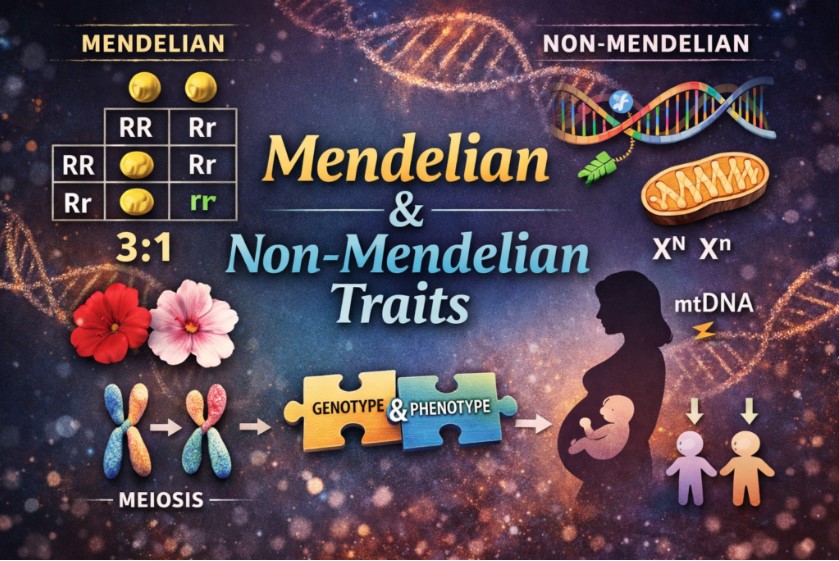
Body
Mendelian Traits: The Classical Model of Inheritance
Mendelian traits are governed by the fundamental principles derived from Mendel’s work:
- Law of Segregation: Each individual carries two alleles for a gene, which separate during gamete formation so that each gamete carries only one allele.
- Law of Independent Assortment: Genes located on different chromosomes assort independently during meiosis.
These principles are rooted in the behavior of chromosomes during meiosis, where homologous chromosomes segregate and recombine, ensuring predictable transmission of genetic material.
In classical Mendelian crosses:
- A monohybrid cross produces a 1:2:1 genotypic ratio
- And a 3:1 phenotypic ratio (dominant:recessive)
For example, crossing heterozygous pea plants results in offspring where dominant traits mask recessive ones, illustrating the principle of dominance.
Thus, Mendelian traits are defined not merely by visible characteristics but by the consistent and orderly transmission of alleles across generations.
Variations within Mendelian Inheritance
A many commonly cited “non-Mendelian” traits actually follow Mendelian laws at the genotypic level, even though their phenotypic ratios differ.
a. Incomplete Dominance
In this case, neither allele is completely dominant, and the heterozygote shows an intermediate phenotype.
For example, red and white flowers producing pink offspring.
Despite the altered phenotype, allele segregation still produces a 1:2:1 genotypic ratio.
b. Codominance
Both alleles express themselves simultaneously in the heterozygote.
A classic example is the AB blood group, where both A and B antigens are expressed.
Here again, the inheritance of alleles follows Mendelian rules.
c. Multiple Alleles
While a gene may have more than two alleles in a population, each individual inherits only two.Thus, inheritance at the individual level remains Mendelian.
d. Sex-linked Traits
Traits linked to sex chromosomes (such as hemophilia) show different patterns in males and females due to chromosomal differences. However, the alleles still segregate according to Mendel’s law during meiosis.
e. Polygenic Traits
Traits like height or skin color are controlled by multiple genes.
Although their phenotypes show continuous variation, each gene involved follows Mendelian inheritance.
These examples demonstrate that variation in phenotypic expression does not imply a violation of Mendelian laws. The difference lies in how alleles interact, not in how they are inherited.
True Non-Mendelian Traits: Deviations from Mendel’s Laws
Non-Mendelian traits are those in which the fundamental principles of segregation or independent assortment are not followed.
a. Cytoplasmic (Organelle) Inheritance
Genes located in mitochondria or chloroplasts are inherited primarily from the mother.
This bypasses the equal contribution of both parents, violating Mendelian expectations.
b. Epigenetic Inheritance
Here, gene expression is influenced by factors such as DNA methylation or histone modification rather than changes in DNA sequence.
These modifications may not be stably transmitted across generations, making inheritance unpredictable.
c. Maternal Effect
In this case, the phenotype of the offspring is determined by the genotype of the mother, not the offspring’s own genotype.
This contradicts the Mendelian idea that phenotype reflects an individual’s genotype.
d. Meiotic Drive
Certain alleles manipulate the process of gamete formation to ensure they are transmitted more frequently than expected (greater than 50%).This directly violates the law of segregation.
These cases represent genuine departures from Mendelian inheritance because they alter or bypass the fundamental mechanisms of allele transmission.
Conclusion
The distinction between Mendelian and non-Mendelian traits is more nuanced than traditionally understood. While Mendelian traits strictly follow the laws of segregation and independent assortment, many traits once labeled as non-Mendelian are now recognized as extensions or modifications of these laws, differing only in phenotypic expression. True non-Mendelian inheritance occurs only when the fundamental mechanisms of allele transmission are disrupted, as in cytoplasmic inheritance, epigenetics, and meiotic drive. Thus, modern genetics emphasizes that the essence of inheritance lies in genotypic transmission, while phenotypic diversity reflects the complexity of gene interactions and environmental influences.