



Introduction
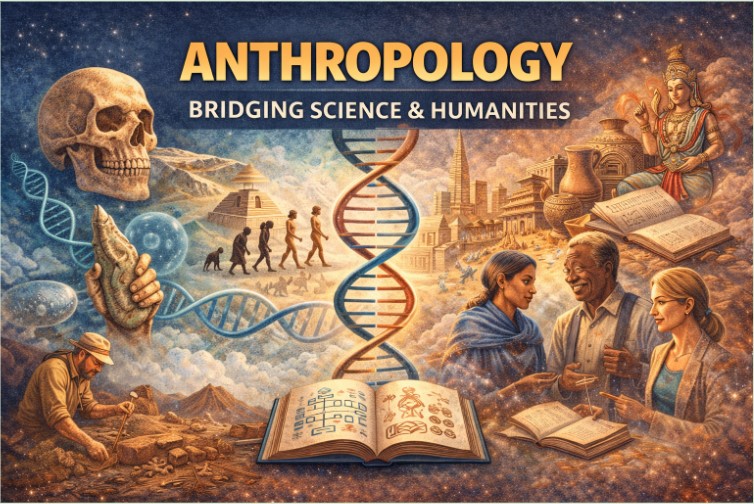
Anthropology, derived from the Greek words anthropos (human) and logos (study), is the scientific study of human beings in all their dimensions. It is characterized by an “infinite curiosity” about humans—when and where they appeared, how they evolved, how they vary biologically, and how societies differ in customs, beliefs, and institutions. Unlike disciplines that focus on a single aspect of human life, anthropology adopts a holistic and global perspective. In doing so, it bridges the gap between science and the humanities, offering a multidimensional understanding of human existence.
Body
Scientific Orientation: Study of Human Biology and Evolution
Anthropology applies scientific methods to investigate human origins and biological variation. It traces human evolution from early ancestors who lived millions of years ago to modern populations. By studying fossils, skeletal remains, genetics, and environmental adaptations, anthropologists analyze how and why humans have changed over time.
The example of lactose intolerance illustrates this scientific dimension. Anthropological research demonstrated that milk intolerance among many populations is due to the absence of the enzyme lactase, rather than poverty or ignorance. Such findings correct misconceptions and show that human biological variation is often an adaptive response to environmental and historical factors.
Thus, anthropology contributes to scientific knowledge about human evolution, adaptation, and diversity.
Humanistic Orientation: Study of Culture, Meaning, and Experience
Anthropology is equally concerned with culture—knowledge, beliefs, art, morals, law, and customs. It examines how societies organize family life, political systems, religion, language, and art. These inquiries require interpretative understanding rather than mere measurement.
For example, understanding the !Kung of the Kalahari Desert involves more than recording their material culture; it requires appreciating how their nomadic lifestyle, minimal possessions, and food-sharing practices are adaptive responses to an arid environment. What may appear “primitive” from one cultural standpoint becomes meaningful when viewed in context.
Anthropology thus engages with values, meanings, and worldviews—areas traditionally associated with the humanities.
Holistic Approach: Integrating Multiple Dimensions A distinguishing feature of anthropology is its holistic orientation. It studies:
- Biological characteristics
- Environmental conditions
- Social organization
- Language
- Political and economic systems
- Religion and art
While specialization exists today, the discipline as a whole integrates these dimensions to present a comprehensive understanding of human life. This integration ensures that biological, cultural, environmental, and historical factors are examined together rather than in isolation.
For example, physical traits such as body build are interpreted in relation to environmental adaptation, while cultural practices such as interpersonal distance are understood as culturally conditioned patterns rather than individual quirks.
Global and Historical Scope
Anthropology differs from many other disciplines in its explicit concern with all varieties of people across all times and places. It studies both ancient and modern humans, Western and non-Western societies, small-scale communities and complex civilizations.
This broad scope prevents culture-bound generalizations. By comparing diverse societies, anthropology tests whether explanations truly apply universally. The skeptical attitude toward unsupported generalizations reflects its scientific rigor, while the comparative perspective fosters cultural relativism and tolerance.
Bridging Science and Humanities
Anthropology bridges science and humanities in several ways:
- It uses scientific methods to analyze biological processes and adaptation.
- It interprets cultural meanings, symbols, and social practices.
- It combines quantitative data (demography, genetics) with qualitative insights (beliefs, rituals, values).
- It applies knowledge practically to address social problems.
By acknowledging both determinism and free will, anthropology challenges the notion that human behavior cannot be studied scientifically while also recognizing the complexity of human thought and culture.
Relevance to Contemporary Society
Anthropology promotes understanding between peoples by explaining differences as adaptive responses rather than deficiencies. Knowledge of cultural variation reduces ethnocentrism and intolerance.
It also provides perspective on humanity’s evolutionary vulnerability and achievements. Understanding our past fosters humility, while awareness of human adaptability inspires confidence in addressing future challenges.
Thus, anthropology contributes not only to academic knowledge but also to social harmony and problem-solving.
Conclusion
Anthropology offers a multidimensional understanding of human beings by integrating biological science with cultural interpretation and historical analysis. Its holistic, global, and comparative approach bridges the divide between science and the humanities. By studying humans across time and space, examining both their physical evolution and cultural creativity, anthropology deepens our understanding of human diversity, adaptation, and potential. In doing so, it stands uniquely positioned to illuminate both the scientific foundations and the humanistic dimensions of our shared existence.