



Critically discuss the centrality of the African continent in the narrative of human evolution. — [15 Marks UPSC 2025]
Introduction
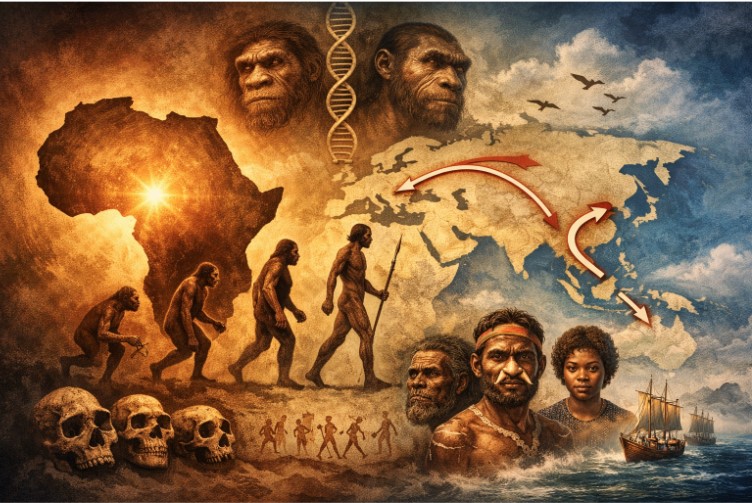
The African continent occupies a central position in the narrative of human evolution, as modern humans are understood to have originated in Africa before dispersing to other parts of the world. However, the precise nature of these dispersals—whether single or multiple, their timing, and routes—has been the subject of considerable debate. While early interpretations based on fossil and archaeological evidence suggested multiple dispersals from Africa, subsequent genetic evidence, particularly from mitochondrial DNA (mtDNA), Y chromosome, and genome-wide data, has reshaped this narrative. A critical discussion of Africa’s centrality must therefore consider both its foundational role and the complexities revealed by recent genetic research.
Body
Africa as the Cradle of Modern Humans
The starting point of the narrative is clear: modern humans arose in Africa. This makes Africa the primary source population from which all non-African populations ultimately derive.
- Early models, such as that of Lahr and Foley (1994), proposed multiple dispersals beginning around 100,000 years ago.
- These dispersals included: An early southern route along the Indian Ocean coast reaching Sahul (Australia–New Guinea) around 40,000–50,000 years ago , later dispersals into Asia and Europe
This model portrays Africa as a continuous source of migrating populations, emphasizing its centrality over an extended period.
Genetic Evidence and the Shift to a Single Dispersal Model
With the accumulation of genetic data, especially mtDNA evidence, a different picture emerged:
- Nearly all non-African mtDNA lineages belong to haplogroups M and N, derived from African haplogroup L3.
- These haplogroups date to approximately 50,000–70,000 years ago.
This pattern suggests:
- A single major dispersal out of Africa rather than multiple independent migrations
- A founder effect, where only a subset of African genetic diversity left the continent
Additional support comes from: Y chromosome data and Genome-wide analyses (e.g., serial bottleneck model)
Thus, Africa remains central, but as the origin of a single key dispersal event, rather than repeated waves.
Genome-Wide Evidence and Refined Models
More sophisticated analyses using genome-wide SNP data have refined this understanding:
- Studies comparing different models show strongest support for: A single dispersal from Africa, followed by multiple dispersals from a non-African source population
- The best-supported model includes:An early southern dispersal to New Guinea, later dispersals to Europe and Asia
This suggests that:
- Africa is central as the point of origin,
- But subsequent human expansion was shaped significantly outside Africa.
Importantly, the classical model of multiple independent dispersals directly from Africa receives very little support.
Evidence from Archaic Admixture
Genetic evidence of interbreeding with archaic humans further supports Africa’s central role:
(a) Neandertal Admixture
- All non-Africans share a common signal of Neandertal ancestry
- This implies: A single dispersal from Africa, followed by interbreeding, likely in the Middle East
- Multiple episodes of interbreeding occurred later, but the shared signal indicates a common origin event outside Africa.
(b) Denisovan Admixture
- Denisovan ancestry is found mainly in: Southeast Asia, Oceania (especially high in Papuans and Australians)
- Absence in some related populations (e.g., Andamanese, Jehai) suggests: A specific dispersal route and timing, likely interbreeding in island Southeast Asia
These findings reinforce that:
- Africa is the starting point,
- But significant evolutionary interactions occurred after dispersal.
Complexity and Limitations of the African-Centric Model
While Africa is central, the narrative is not simple:
- Genetic models depend on assumptions and simulations, which may not fully capture real population dynamics.
- Factors such as: Migration after divergence, Gene flow between populations, Ascertainment bias in SNP data can affect interpretations.
- Evidence suggests: Possible early dispersals that left little genetic trace, multiple episodes of archaic admixture, back migrations and complex population interactions
- New findings indicate: Denisovan ancestry at low levels across East Asia and the Americas, possible earlier modern human dispersals (~100,000 years ago) that later went extinct
Thus, the narrative is increasingly seen as complex and dynamic, rather than a simple linear expansion from Africa.
Africa’s Centrality Revisited
From the available evidence, Africa’s centrality can be understood in three key ways:
- Origin of modern humans
- Source of the primary dispersal event that populated the rest of the world
- Reservoir of greatest genetic diversity, from which non-African diversity is a subset
However, once humans left Africa:
- Evolutionary processes such as adaptation, admixture, and dispersal occurred independently
- These processes significantly shaped modern human diversity
Conclusion
Africa remains central to the narrative of human evolution as the birthplace of modern humans and the source of the primary dispersal that gave rise to all non-African populations. Genetic evidence strongly supports a single major dispersal event, followed by complex patterns of migration and interaction outside Africa. However, this centrality must be understood in a nuanced manner: while Africa provides the origin, the subsequent history of human evolution is marked by multiple dispersals, archaic admixture, and regional differentiation. Thus, the African continent is foundational but not exclusive in shaping the evolutionary trajectory of modern humans.