



Introduction
The Miocene epoch (23–5 million years ago) occupies a decisive position in primate evolution because it witnessed the wide radiation of hominoids across Africa, Europe and Asia. The fossil remains discovered from this period provide crucial evidence regarding the divergence of apes and the origin of the human lineage. The Miocene hominoids reveal a stage when different evolutionary experiments were underway—some leading toward modern great apes, some toward hominids, and others representing specialized side branches.
Body
Pliopithecus and Limnopithecus:
The genera Pliopithecus (Europe) and Limnopithecus (East Africa) are considered closely related and possibly members of a single genus. Although their dentition resembles that of modern gibbons, their skeletal structure differs significantly:
- Forelimbs were not excessively elongated.
- Trunk was long with an elongated lumbar region.
- Thorax was narrow and deep.
These features suggest primarily quadrupedal locomotion. However, certain features of the sternum and clavicle indicate partial adaptation for arm-swinging (brachiation). Modern gibbons represent an extreme specialization of traits that were only moderately developed in these Miocene forms. Thus, Pliopithecus and Limnopithecus illustrate an intermediate stage before full brachiating adaptation evolved.
Oreopithecus:
Oreopithecus, discovered in lignite deposits of Tuscany in the late 19th century, generated considerable debate. The recovery of a nearly complete skeleton in 1958 revealed:
- A pelvis and leg capable of bipedal locomotion.
- A well-developed anterior inferior iliac spine associated with erect posture.
- Foot bones indicating partial terrestrial adaptation.
Morphologically, Oreopithecus shows resemblances to great apes, humans, and even cercopithecoids. Because of its distinctive features, many scholars assign it to a separate family, Oreopithecidae.
Its significance lies in demonstrating that certain traits associated with hominid adaptation—particularly bipedal features—appeared within Hominoidea as early as 12 million years ago. However, it is considered a highly specialized and possibly aberrant lineage rather than a direct ancestor of humans.
The Dryopithecine Group:
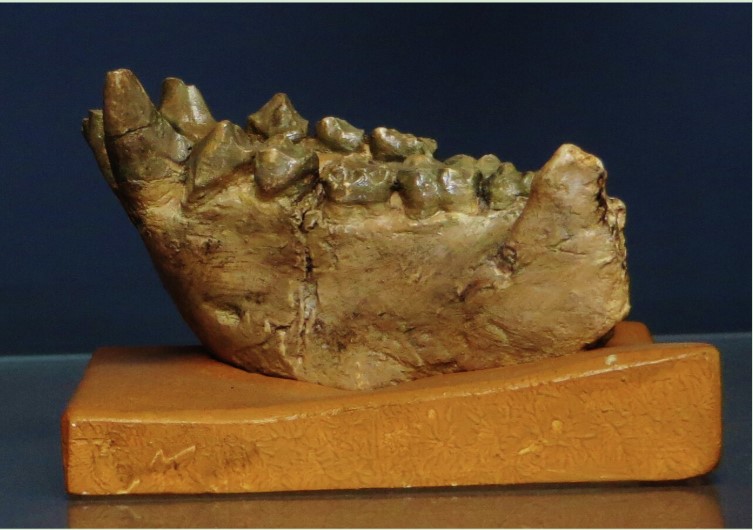
The dryopithecines represent the most important Miocene hominoid radiation. Earlier, numerous fragmentary finds were assigned to separate genera, but later systematic study reduced them mainly to three principal genera: Dryopithecus, Ramapithecus, and Gigantopithecus.
(a) Dryopithecus
- Found from early Miocene to Pleistocene deposits.
- Large canines and sectorial lower premolars.
- Molars elongated and increasing in size posteriorly.
- Limbs generalized, without specialization for brachiation or bipedalism.
Some African species such as D. africanus and D. major show resemblances respectively to chimpanzees and gorillas, including sexual dimorphism in body and tooth size. These features suggest that Dryopithecus likely gave rise to modern pongids (chimpanzees and gorillas).
(b) Ramapithecus
- Smaller body size, about that of a gibbon.
- Reduced incisors and canines.
- Arched palate and shorter muzzle.
- Non-sectorial premolars and distinctive molar cusp patterns.
Ramapithecus is assigned to the family Hominidae and is considered ancestral to Pleistocene hominids. The reduction in canine size suggests diminished reliance on teeth for grasping and tearing, implying greater use of hands and possibly incipient bipedalism.
(c) Gigantopithecus
- Extremely large jaws and teeth.
- Assigned to a separate pongid subfamily.
This genus represents a specialized lineage demonstrating the ecological diversity of Miocene apes.
Evolutionary Implications
The Miocene hominoid record demonstrates:
- Divergence of Hominidae and Pongidae: The split likely occurred in the Miocene, with Dryopithecinae forming a common ancestral stock.
- Adaptive Radiation: Hominoids spread across Eurasia and Africa, occupying diverse ecological niches.
- Dental Evolution: Progressive reduction in incisors and canines in Ramapithecus marks a shift toward hominid adaptive patterns.
- Locomotor Trends: From generalized quadrupedalism to brachiation (gibbons) and toward bipedalism (hominids).
- Taxonomic Challenges: Fragmentary fossil material led to excessive genus creation; later synthesis emphasized careful comparative analysis.
Conclusion
The Miocene hominoid remains provide a comprehensive picture of early ape diversification and the emergence of hominid traits. Genera such as Pliopithecus and Limnopithecus reveal transitional stages in locomotor adaptation; Oreopithecus demonstrates early experimentation with bipedal features; and the dryopithecines form the critical link between ancestral apes and both modern great apes and early hominids. Collectively, these fossils illuminate the evolutionary processes that shaped the divergence of pongids and hominids and laid the biological foundation for the later emergence of Australopithecus and Homo.