



Introduction
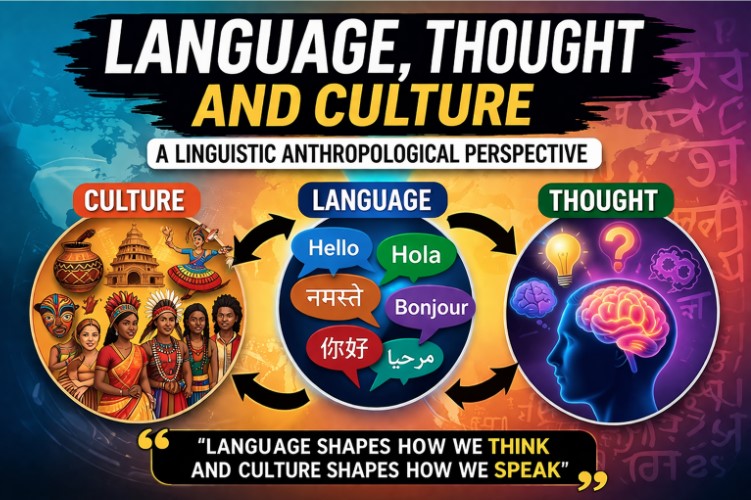
The relationship between language, thought, and culture has been a central concern in linguistic anthropology for over a century. Scholars have debated whether language determines thought, reflects cultural realities, or interacts dynamically with both. Beginning with Franz Boas and further developed by Edward Sapir and Benjamin Lee Whorf, theoretical perspectives have evolved from rejecting linguistic hierarchies to recognizing a complex, multidirectional relationship. Contemporary linguistic anthropology now views language, thought, and culture as mutually constitutive, shaping and influencing one another in subtle yet significant ways.
Body
1. Boasian Perspective: Cultural Relativism and Equality of Languages
Franz Boas laid the foundation by challenging ethnocentric and racist assumptions that some languages were “primitive” and incapable of expressing abstract or scientific thought. He argued that:
- All languages are equally complex, logical, and capable of expressing any idea.
- Differences in language reflect differences in cultural practices and habitual patterns, not cognitive limitations.
- Language can provide insight into unconscious cultural patterns, but it does not rigidly determine thought.
Boas thus introduced the principle of cultural relativism, emphasizing that linguistic structures must be understood within their cultural contexts. Language, in this view, is a reflection of culture rather than a constraint on cognition.
2. Sapir’s Perspective: Language as a Structuring Force
Edward Sapir extended Boas’s ideas but gave greater importance to the role of language in shaping perception:
- Language habits of a community predispose individuals to interpret the world in particular ways.
- Grammatical categories evolve into complex systems that influence how reality is perceived and organized.
- Language exerts a “tyrannical hold” on thought in the sense that it subtly guides habitual interpretation.
However, Sapir did not support determinism. He emphasized that:
- All languages are grounded in a shared human cognitive capacity.
- Any idea can be expressed in any language.
Thus, Sapir proposed a strong but flexible relationship, where language influences thought without restricting it.
3. Whorf’s Perspective: Linguistic Relativity and Worldview
Benjamin Lee Whorf further developed these ideas into the concept of linguistic relativity:
- Language consists of interrelated categories, many of which operate below conscious awareness.
- These categories shape a worldview, influencing habitual thought and cultural behavior.
His famous comparison between Hopi and Standard Average European (SAE) languages illustrates this:
- Hopi language emphasizes process, continuity, and cyclical time, leading to cultural values of endurance and preparation.
- SAE languages treat time as countable and measurable, encouraging practices like scheduling, record-keeping, and quantification.
Whorf argued that such linguistic differences can lead to systematic differences in how people experience reality, though not in an absolute or deterministic way.
4. The Sapir–Whorf Hypothesis: Clarifying Misconceptions
The term “Sapir–Whorf Hypothesis” has often been misunderstood:
- Strong version (Linguistic Determinism):
- Language rigidly determines thought
- Leaves no room for alternative thinking
- Widely rejected as simplistic and incorrect
- Weak version (Linguistic Relativity):
- Language predisposes or influences thought
- Allows flexibility and cognitive diversity
- Accepted by most contemporary scholars
Importantly, Sapir and Whorf themselves never formulated a formal hypothesis, and their ideas were more nuanced than later interpretations suggest.
5. Contemporary Perspective: Mutual Interaction Model
Modern linguistic anthropology emphasizes a multidirectional and interdependent relationship:
- Language, thought, and culture influence one another simultaneously
- None of the three can be studied in isolation
- The relationship is dynamic, flexible, and context-dependent
This perspective also introduces the idea of semiotic mediation:
- Meaning is constructed not only through language but also through symbols, gestures, images, and material culture
- Social reality itself is mediated through signs, making language central but not exclusive
Some scholars treat this relationship as an axiom, arguing that all aspects of social life are linguistically mediated and cannot be separated for empirical testing.
6. Cognitive Approaches: Categories, Metaphors, and Frames
Recent research focuses on how language shapes cognition through:
a. Categories
- Categories are not fixed; they emerge from human experience and cultural interaction
- Language organizes these categories, influencing perception
b. Metaphors
- Different languages use different metaphors, shaping thought:
- English: “Time is money” → emphasizes efficiency and measurement
- Hopi: Time as cyclical process → emphasizes continuity and repetition
c. Frames
- Words evoke frames or worldviews that shape interpretation
- For example, describing taxes as a “burden” vs “community responsibility” creates different cognitive responses
d. Hypocognition
- Lack of linguistic categories can limit the ability to express or conceptualize certain experiences, such as grief in some cultures
These approaches demonstrate that language actively participates in meaning-making and structuring reality.
Conclusion
Theoretical perspectives in linguistic anthropology reveal that the relationship between language, thought, and culture is complex, dynamic, and deeply interconnected. From Boas’s emphasis on cultural equality to Sapir’s recognition of linguistic influence and Whorf’s articulation of linguistic relativity, the field has moved away from deterministic explanations toward a nuanced understanding of mutual interaction. Contemporary approaches further highlight the role of categories, metaphors, and semiotic systems in shaping human cognition and cultural practices. Ultimately, language does not confine thought but provides a powerful framework through which individuals perceive, interpret, and engage with the world.