



How anthropologists assess the nutritional status of a community? Discuss the significance of intersectionality of ecology, culture, and social inequality in the study of nutritional anthropology. — [ 20 Marks UPSC-2025]
Introduction
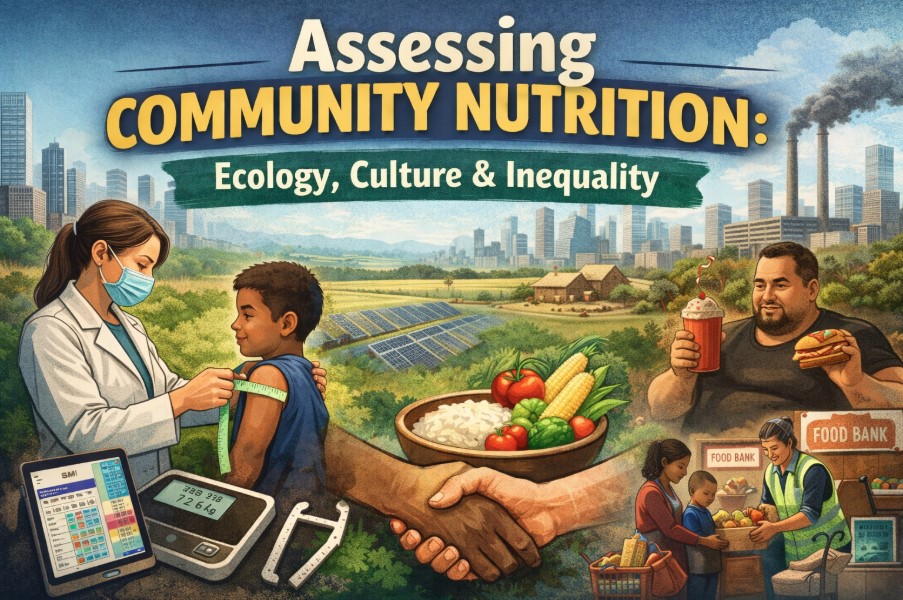
Nutritional anthropology is a biocultural field that seeks to understand how human beings use food to meet biological requirements while simultaneously expressing economic, social, and cultural meanings. Food is not merely a bundle of nutrients; it is also a commodity shaped by political economy and a symbol embedded in social and religious life. Therefore, the assessment of nutritional status in a community requires more than measuring calories or body weight—it demands an integrated understanding of biology, ecology, culture, and inequality.
Body
Assessment of Nutritional Status of a Community
Anthropologists assess nutritional status through a combination of quantitative and qualitative methods, working at the level of individuals, households, and communities. This integrated methodology reflects the complexity of nutrition as both a biological process and a sociocultural phenomenon.
1. Anthropometric Assessment
One of the most basic and widely used approaches is nutritional anthropometry, which involves measuring variations in body size and composition across age groups and nutritional levels. Common measurements include height (stature), body weight, mid-upper arm circumference, and skinfold thickness. From these measurements, indices such as weight-for-height, height-for-age, weight-for-age, and Body Mass Index (BMI) are calculated.
These indices are compared to reference populations to determine whether individuals or groups are undernourished, stunted, wasted, overweight, or obese. Anthropometry is especially valuable because it is non-invasive, inexpensive, and suitable for both short-term surveys and long-term growth monitoring. It provides insight into past nutritional history as well as current status.
For more detailed body composition assessment, methods such as Bioelectrical Impedance Analysis (BIA) may be used in field settings. Though sophisticated techniques like MRI exist, they are often impractical in community-based research.
2. Dietary Assessment Methods
Since nutritional status is directly linked to food intake, anthropologists carefully document dietary patterns. Two widely used methods are:
(a) 24-Hour Dietary Recall:
This method records all foods and beverages consumed during the previous day. It is relatively easy to administer and suitable for community-based research. To improve accuracy, repeated recalls are conducted across different days and seasons. Researchers often use food models, photographs, and household utensils to help respondents estimate portion sizes accurately.
(b) Food Frequency Questionnaire (FFQ):
This tool captures usual food consumption patterns over a longer period. It categorizes foods and records how frequently they are consumed—daily, weekly, or monthly. FFQs help in understanding dietary diversity and identifying patterns associated with health conditions such as obesity, diabetes, or micronutrient deficiencies.
After collecting dietary data, anthropologists analyze nutrient intake—carbohydrates, proteins, fats, vitamins, and minerals—using food composition tables or computerized nutrient databases. These values are then compared with recommended dietary allowances to evaluate adequacy.
3. Qualitative and Ethnographic Methods
Nutritional anthropology is distinguished by its use of qualitative methods to contextualize biological data. Anthropologists employ participant observation, interviews, focus group discussions, and rapid assessment procedures to understand:
- Cultural beliefs about food
- Food taboos and ritual practices
- Gender-based food allocation
- Age-specific feeding practices (e.g., weaning foods)
- Household decision-making in food purchase and preparation
Through ethnographic observation, anthropologists capture seasonal food shortages, special ceremonial consumption, and hidden patterns of food distribution that quantitative tools may overlook. Qualitative analysis helps explain why certain nutritional problems persist even when food appears available.
4. Multidisciplinary Integration
Because nutrition is influenced by agriculture, economics, epidemiology, and public health, anthropologists often incorporate methods from these fields. Geographic Information Systems (GIS) may be used to map food access. Public health assessments help examine diet–disease interactions. Economic studies clarify how market forces and globalization influence household food choices.
Thus, nutritional assessment becomes a comprehensive investigation into how biological and social processes interact.
Significance of the Intersection of Ecology, Culture, and Social Inequality
Nutritional anthropology emphasizes that nutritional status emerges from the intersection of ecological conditions, cultural practices, and structural inequalities.
Ecology
Ecological factors determine food production, availability, and energy expenditure. Climate, seasonality, soil quality, and environmental degradation affect what foods can be grown or accessed. Energy intake must be understood in relation to physical labor demands and environmental stressors.
Culture
Food carries symbolic and social meaning. Cultural norms define what is edible, who eats first, what foods are appropriate for children or pregnant women, and which foods are reserved for rituals. Cultural perceptions of body image and health also influence dietary choices. Thus, nutrition cannot be reduced to calories; it is deeply embedded in systems of belief and identity.
Social Inequality and Political Economy
Economic disparities and political structures strongly shape nutritional outcomes. Poverty limits access to diverse and nutritious foods. Market integration and globalization may replace traditional diets with processed foods, contributing to obesity and chronic diseases. Marginalized groups—particularly women and children—often experience disproportionate burdens of malnutrition.
The concept of intersectionality highlights how ecological vulnerability, cultural norms, and socioeconomic status interact to produce unequal nutritional outcomes within and between communities.
Conclusion
Anthropologists assess the nutritional status of a community through a holistic framework that integrates anthropometric measurements, dietary analysis, and qualitative ethnographic inquiry. However, nutritional status is not simply a biological measurement; it is the outcome of complex interactions among ecological conditions, cultural meanings, and social inequalities. By recognizing this intersectionality, nutritional anthropology provides a comprehensive understanding of malnutrition, obesity, and diet-related diseases and contributes to the development of culturally sensitive and socially informed interventions.