



Introduction
The origin of food production represents a turning point in human history, marking the transition from a foraging way of life to a settled agricultural economy, widely known as the Neolithic Revolution. Earlier explanations viewed agriculture as a simple discovery that spread once recognized, but modern research shows that hunter-gatherers already possessed knowledge of plant growth. The key question, therefore, is not discovery but why certain groups chose to adopt agriculture. Over time, multiple theories have been proposed, emphasizing environmental change, population pressure, social factors, and human adaptation. Together, these models provide a more nuanced understanding of the origins of food production.
Body
Major Theories Explaining the Origin of Food Production
(a) The Oasis Model (Environmental Change)
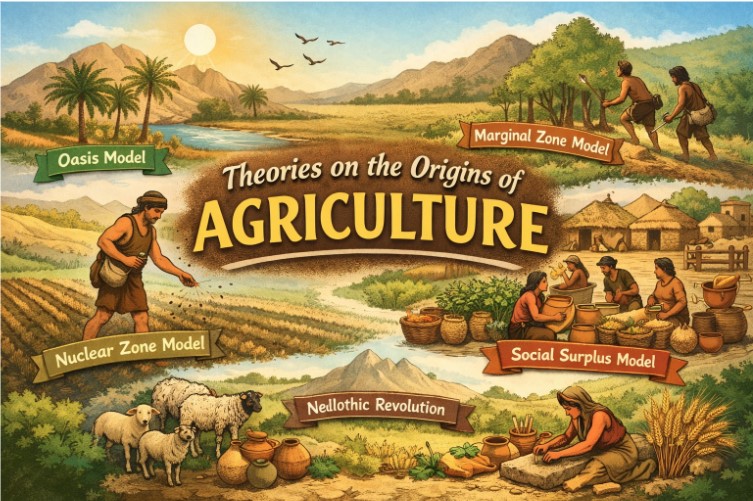
Proposed by V. Gordon Childe, this model links the origin of agriculture to climatic desiccation at the end of the last Ice Age.
- Increasing dryness forced humans, plants, and animals into limited fertile zones (oases).
- Close association between humans and other species encouraged intentional cultivation and domestication to ensure a stable food supply.
Evaluation:
While the model was important in highlighting environmental factors, later studies showed that climatic change was not uniformly severe, and thus cannot alone explain the shift to agriculture.
(b) The Nuclear Zone Model (Hilly Flanks Hypothesis)
Proposed by Robert Braidwood, this model emphasizes regions where wild ancestors of domestic plants and animals were naturally abundant.
- Agriculture originated in upland “nuclear zones”, particularly in areas rich in wild wheat and barley.
- As foragers settled in these regions, they developed greater familiarity and specialization, eventually leading to experimentation and domestication.
Significance:
This model shifts focus from environmental stress to human knowledge, adaptation, and gradual innovation, linking domestication to increasing efficiency in resource use.
(c) The Marginal Zone Model (Edge Hypothesis)
Advanced by Binford and Flannery, this theory emphasizes ecotones and marginal environments.
- Groups living in less favorable areas faced resource scarcity and subsistence stress.
- These pressures encouraged experimentation with new subsistence strategies, including domestication.
- Domestication likely occurred outside core areas, where new environmental conditions led to genetic changes in plants and animals.
Importance:
Highlights that innovation often arises not in abundance, but under conditions of necessity and pressure.
(d) Population Pressure and Sedentism
Closely related to the marginal zone model, this explanation focuses on demographic changes.
- Sedentary communities, such as the Natufian culture, led to population growth.
- Increasing population exceeded the carrying capacity of the environment.
- Groups were forced to either migrate or intensify food production, leading to domestication.
Insight:
Agriculture is seen as a response to resource stress generated by population increase and reduced mobility.
(e) Social Pressure Model
Proposed by Bender (1978), this model emphasizes social and political motivations.
- Early agricultural societies sought to produce surpluses, not merely subsistence.
- Surplus food supported:Ritual activities , Social obligations , Political hierarchies (e.g., tribute to leaders)
Significance:
This model highlights that agriculture was also driven by social competition, organization, and cultural needs, not just survival.
(f) Composite Model (Henry, 1989)
Henry integrates multiple variables into a holistic explanation:
- Initial climatic improvement expanded the availability of wild cereals.
- This led to sedentary settlements and population growth.
- Increased social complexity required mechanisms such as rituals and cooperation.
- A subsequent dry phase reduced resources, forcing communities to cultivate plants in well-watered areas.
Importance:
This model reflects the contemporary view that agriculture emerged through the interaction of environmental, demographic, and social factors, rather than a single cause.
Revolutionary Changes in Subsistence Economy
The transition to agriculture brought profound and long-term transformations:
(a) Shift from Foraging to Food Production
- Replacement of hunting–gathering with systematic cultivation and animal domestication
- Emergence of: Horticulture (small-scale cultivation using simple tools), Pastoralism (management of domesticated animals)
(b) Emergence of Sedentary Life
- Establishment of permanent settlements and villages
- Reduced mobility and increased dependence on local resources
(c) Technological Innovations
- Development of polished stone tools characteristic of the Neolithic
- Emergence of innovations such as: Pottery (a secondary innovation based on earlier knowledge of fired clay) , Improved tools for cultivation and storage
(d) Population Growth and Demographic Change
- More reliable food supply supported larger populations
- Led to increased density of settlements and expansion into new areas
(e) Social and Economic Transformation
- Production of surplus food enabled: Social differentiation, Emergence of leadership and hierarchy, Increased ritual and ceremonial life
(f) Independent Origins and Global Spread
- Agriculture developed independently in multiple regions such as Southwest Asia, East Asia, Mesoamerica, and the Andes
- Spread gradually over centuries and millennia, reflecting regional adaptations
Conclusion
The origin of food production was a complex and multifaceted process shaped by environmental change, population pressure, social dynamics, and human innovation. No single theory fully explains its emergence; rather, models such as the Oasis, Nuclear zone, Marginal zone, and composite approaches collectively illuminate different aspects of this transition. The shift in subsistence economy during the Neolithic period was truly revolutionary, as it transformed human societies from mobile foragers into settled agricultural communities, leading to far-reaching changes in technology, population structure, social organization, and cultural development. This transformation laid the essential foundation for the rise of complex civilizations in later history.